Thursday, October 15, 2015

The Lion King Film Response

I knew that it was coming. I'd seen it so many times that I could literally close my eyes and picture the scene, but when I watched Mufasa die while watching The Lion King this past weekend, I couldn't help but feel a huge lump in my throat once again. There's just something about the scene that is so powerful and human that it's impossible not to feel emotionally ravaged. In many ways, I feel like the emotional depth of that one scene encompasses the film as a whole which arguably plays with the viewer's emotions more than any other Disney film.


Despite the cruel tragedy of Mufasa's death, The Lion King is undoubtedly one of my favorite non-Pixar Disney films out there. Unlike other stereotypical Disney "love story blah blah blah" films, The Lion King took a more unique coming of age bildungsroman approach that results in an epic overarching storyline that follows Simba's growth in a true lion king. While the film certainly has its flaws as we discussed in class that send negative messages regarding a stratified social hierarchy. While I understand that Disney may very well have intended to promote a rigid class hierarchy. In addition, racism is peppered throughout the film with the hyena's voiced by Whoopi Goldberg and Cheech Marin. Despite these apparent shady aspects in the film, I can openly admit that a mixture of nostalgia and legitimate appreciation for the film makes me more than slightly biased when it comes to The Lion King.

Me holding an actual baby lion like Simba is one of my life's defining moments


What makes the film truly special to me is that despite there being no actually human characters, the plot feels more human than any other Disney film. While other films have a somewhat superficial aspect to them with a forced and overly formulaic love story, The Lion King puts its love story as a secondary plot element to Simba's evolution and story arc, something that I've always loved. Moreover, The Lion King is an incredible film that I could write about for way more than I should, so I'm just gonna end my blog with the intro to the film that plays "The Circle of Life", one of my top 3 favorite songs.


Monday, October 12, 2015

The Little Mermaid Film Response

I truly wish I could’ve made another live blog response for Disney’s The Little Mermaid like I did for Snow White and the Seven Dwarves, I just flat out forgot to live record my view experience. Despite my forgetfulness, I’m excited by the fact that I’ve had time to brood over and analyze the overt as well as clandestine messages hidden within The Little Mermaid. Before I get to the spicy stuff, I just wanted to put it out there that animation-wise, I was somewhat shocked by how minimally the animation changed between Snow White and The Little Mermaid. Don’t get me wrong, the animation style in The Little Mermaid isn’t poorly done or bad in the least, it’s just that I was surprised by how on par the animation of the two films were. Even the animation in water in The Little Mermaid holds very little over the water effects in Snow White, which I’m now starting to realize must have been truly revolutionary for the time period in which the movie was released, but I digress.

It's good, but not that much better than Snow White

Overall, The Little Mermaid is a drastically huge improvement over Snow White and the Seven Dwarves for several different reasons, the main reason being it’s focus on plot. Although Snow White dazzles viewers with its technologically advanced animation effects, I think it’s fair to say that the story is about is one-dimensional and predictable as it gets. The Little Mermaid, on the other hand, is noticeably more layered, starting with the protagonist, Ariel. Unlike Snow White, who is both weak-willed and uninspiring, Ariel is far more complex with a vast array of emotions and motivations that drive the story in various directions. While many make valid criticisms of Ariel’s assumption of many gender role stereotypes, I think that the film still does a good job of using Ariel as a portrayal of the feminine ability to rebel from a patriarchal figure, such as Triton. Also, I think that Eric is a vastly better prince than the creepster from Snow White. While he also has his flaws and superficial tendencies, I think that Eric is also an underhandedly multifaceted character that experiences an internal struggle between doing what people expect from him as a prince and what pursuing what he personally desires. Finally, I have to touch on Ursula. Although in my opinion Ursula is a slightly more annoying villain than the Wicked Queen in Snow White, I do think that Ursula is a more effective villain, due to her dastardly plan of using Ariel as a means to take power away from Triton. The Wicken Queen is motivated by largely superficial reasons, whereas Ursula is driven by her dogged chase for power. While she is undoubtedly flawed, I personally find a complex villain vastly more effective. Take the Joker for example, he has so many layers that he might as well be an onion (gotta love the Shrek references).


While The Little Mermaid certainly has its imperfections, it is undeniably entertaining and asserts itself as a huge improvement for the evolution of Disney films in terms of plot and character development.

Sunday, October 4, 2015

Disney, "The Evil Corporation", Strikes Again

While we primarily study the actual themes and ideas put forth in Disney's movies/shows, I always enjoy reading about up-to-date information about Disney itself as a corporation. As of today, October 4, Disney is  significantly raising its prices on Disneyland tickets. In the article attached at the end of this paper there is an explanation that "the latest price increase specifically targets Disneyland’s annual passholders, a core base that many unofficial Disney blog sites estimate at 1 million. Some have speculated the recent ticket increases are a much-needed way to reduce the large crowds that occurs at Disneyland during some weekends and high-demand seasons."It's hard not to laugh at the ridiculousness of this statement by Disney. The company has legitimately become so unbelievably successful that they can afford to raise the price of their Disneyland tickets so that they can reduce the number of people that come to visit their amusement park. If there's one thing that Wasko got right, it's that Disney as a company is truly an empire that shows no sign of slowing down.

The Disney Empire Strikes Back

Trites Reading Response: "The Little Mermaid"

To say that Roberta Trites' piece was just an interesting read would be a gross understatement. Never before would I have pictured myself reading scholarly articles that equate Triton's trident to a phallic symbol of power or Urusula's cleavage to a suffocating perversion of the female body. While it would be easy to just write Trites off as another writer who is just reaching too far in her arguments (which she definitely does at times), I actually found this article not only entertaining but also highly engaging.


In her article, Trites makes the point that Disney changes many aspects of Hans Christian Anderson’s original mermaid tale, thus making the story more sexist (whether intentionally or unintentionally). One of the points that she provides to reinforce her argument is that in the original story, the mermaid is seeking out a soul. “She decides she will risk everything ‘to win him and an immortal soul’” and as a consequence, the mermaid thinks the two go hand in hand. Conversely, Disney’s Ariel is fighting for a man rather than a soul.  Because of this, Trites argues that Disney sends the message that women, in order to become independent of their fathers, must become dependent on another man instead. While Trites goes a little too far with her analysis of Ursula as the representation of Satan who takes advantage of Ariel's dependence, Trite make the important point that Usula is an accurate depiction of the way by which Disney depicts women as objects who don't need to use their voice or personality, but rather their body to get what they want.


Additionally, I found that Trites' point about the superficiality of her obsession with humans to be provocative. I thought it was interesting that she mentions how Ariel has very little idea of how humans actually are, so her obsession with humans becomes increasingly materialistic, as demonstrated by her singing about the "neat stuff" that she assumes represents humankind.


Moreover, while Trites definitely overextends herself in some areas of her agument in the most hilarious ways possible, her piece really does make some valid points about the impact of Disney's influence on Hans Christian Andersen's original tale in making the story sexist and even ridiculous at times.

Monday, September 28, 2015

Fun Supermoon Image

This is an extremely short post, but I just saw this photoshopped picture in honor of the supermoon that happened last night and couldn't help but blog about it. While those of us at Duke weren't able to see the moon last night in person because of the absurdly thick cloud coverage, there have been some great pictures of the supermoon posted online. This picture of the Mickey Mouse supermoon, however, by far takes the cake.


If anything, this picture goes to show how relevant Mickey Mouse is in media even today.

Sunday, September 27, 2015

Schwartz Reading Response: "Dopey's Legacy: Stereotypical Portrayals of Intellectual Disability in the Classic Animated Films"

As an optimist, I usually like to give Disney the benefit of the doubt when the company is accused of promoting negative messages of spreading the wrong ideals in the films. Although I would like to believe that Disney did not purposely set out to express contempt towards individuals with intellectual disabilities in its movies, the arguments presented by Schwartz are truly compelling in her article “Dopey’s Legacy”. By structuring her argument effectively by utilizing a clear and concise thesis statement, well-reasoned and logical points and most importantly, Schwartz provided ample evidence to validate her controversial claims. I really enjoyed this piece because of the thought-provoking manner in which it discusses the topic of mental or physical disability in the context of Disney, something that I had never even though to consider before.

With mental/physical disabilities still being major issues in society today, I'm surprised that so few people write about the topic as it relates to film and television. In this piece, Schwartz not only presents one example of Disney’s stereotypical portrayal of individuals with intellectual disabilities, but three, with each example displaying shocking evidence. Schwartz chose to deal with the highly entertaining and comical characters of Dopey from Snow White, Gus from Cinderella and Le Fou from Beauty and the Beast. While these characters are from very different films, from different time periods they are all connected by the fact that they all share three common characteristics of being 'childlike, non-human and fools/’The village idiot’. After reading the piece, however, I noticed that the points made about Dopey are much stronger the the arguments for Gus and Le Fou. It is clear that Schwartz is trying to use multiple examples of different characters showing physical or mental disability over different time periods in Disney's History, but Schwartz stumbles somewhat with the execution. In particular, I disliked his examples of Le Fou in that it is fairly clear that he struggles to make as strong of an example as he makes for Dopey.

I also really enjoyed this piece for the personal reason that it was particularly pertinent to my topic for our class' first essay for defending/refuting a Disney film. Choosing to write about the role of education in Tarzan as an empowering and humanizing tool. While reading Schwartz' piece I couldn't help but notice the parallels between Tarzan/gorillas and Dopey/Gus/Le Fou as being depicted as sub-human due to disabilities of some sort. Looking at this topic through the perspective of my paper, I was able to notice the truly appalling examples of disability in Disney films that exclude those with disability as the "other". Moreover, while "Dopey's Legacy" has a few weak points, I truly enjoyed the piece for the way in which it made me think about disability in our society and how it is portrayed in media. And the piece helped me get a quote for my paper which never hurts.

Saturday, September 26, 2015

Ranking the Best Disney Films by Era

With my mind currently on the millions of college football rankings and statistics (and Duke's lack of a ranking for a football ranking), I've decided to pick the best Disney films from each of the major Disney eras. Before I actually pick the best movies, I guess I have to preface this post with an actual explanation of the distinct Disney eras, so here we go:

Fairy Tale era (Snow White --> Sleeping beauty) : What many I along with many others would characterize as the "Walt Era", the fairy tale era is defined by idealized protagonists, innocence triumphant over ambitious evil, doofus comic relief, Walt's era.

The Dark age (101 Dalmations --> Oliver & Company): Disney's dark age contains storylines with adventurous protagonists, bands of misfits, an emphasis on urban environments and villains based on vice.

The Disney Renaissance (The Little Mermaid --> Home on the Range)Following the "dark age", Disney changed things up a little by making movies with proactive protagonists, stories based on classic literature & folk tales, a heavy Broadway influence and first major use of CGI.

The Disney Revival (Chicken Little --> Present): Defined by protagonists & stories that subvert classics, influenced by Pixar and DreamWorks, traditional animation secondary to CGI and less emphasis on villains with more on social and emotional problems.

Now that you know each Disney era a little better, I'll give you a list of my favorite film from each era:

Fairy Tale era: This era is probably the easiest for me because it's my least favorite period of Disney films, excluding Pinocchio. There's just something about Pinocchio that's not only so epic for its time but also truly genuine. Truly a timeless movie in my honest opinion.

So epic


Dark age: Another easy one that goes to The Many Adventures of Winnie the Pooh. While this movie is a classic with Winnie the Pooh being a true icon, Winnie the Pooh also holds some personal significance to myself. For whatever reason, Winnie the Pooh was my absolute favorite movie as a toddler and so my first christmas ornament ever was a Winnie the Pooh ornament that I hang on my family's Christmas tree each year. So yeah, Winnie the Pooh is pretty awesome.

Two of Disney's biggest franchises merged 


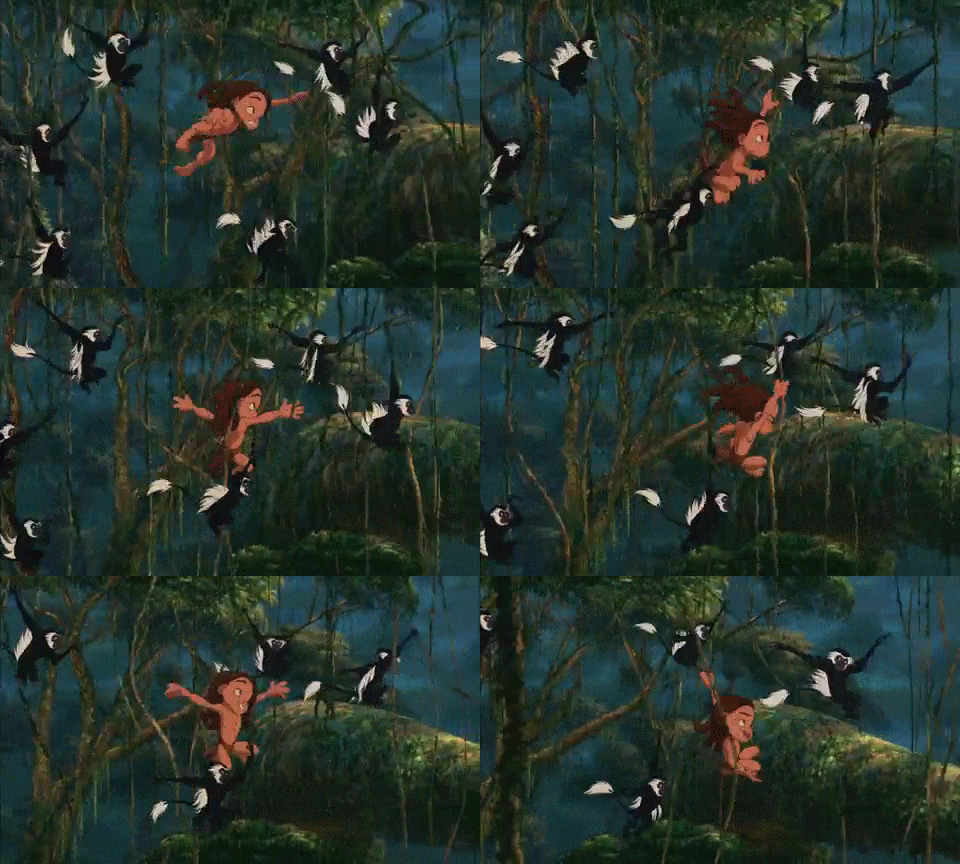
Disney Renaissance: Although this time period includes some of my favorite Disney films, I have to go with Tarzan as my victor. I've always loved rock climbing and the outdoors since I've been a little kid, so from the first time I saw Tarzan I wanted to be like him and swing from the vines in the jungle Spider-man-style. Close second goes to Lilo and Stitch.


Disney Revival: With this era being my favorite, I have no clearly favorite film. Pixar truly shines in this era and while I love every single Pixar film, I have to go with The Incredibles as my favorite movie from this era. The Incredibles just has the absolute perfect combination of fun, action, storyline, and pretty animation; I can't wait for the sequel.