Wednesday, November 4, 2015

Sweeney Reading Response: Timon and Pumba in The Lion King

Within the text of Gael Sweeney's “’What Do You Want Me to Do? Dress in Drag and Do the Hula?’ Timon and Pumbaa’s Alternative Lifestyle Dilemma in The Lion King,” the main argument proposed is that Timon and Pumbaa are Disney’s first representation of non-heteronormative partners. She bases this conclusion with their exaggerated, “flamboyant” behavior, their statuses as outcasts, and specifically Timon’s affinity for the Broadway spotlight.

Unlike other arguments that some scholars make about Disney, I actually agreed with much of what Sweeney has to say about the role of heteronormativity in Disney. According to Sweeney, much of Timon and Pumbaa’s characteristics and mannerisms reflect the persona of their respective voice actors, Nathan Lane and Ernie Sabella. Because the two were Broadway actors, Sweeney suggests that Timon and Pumbaa’s exaggerated actions are given a deeper meaning by those who voice them. Due to that fact that Nathan Lane was openly gay, I found it logical for Sweeney to draw the conclusion that Disney animators purposefully created Timon with homosexual characteristics as demonstrated by their decision of who to voice Timon. But who knows, everyone love a 'lil hula dancing every once in awhile. 
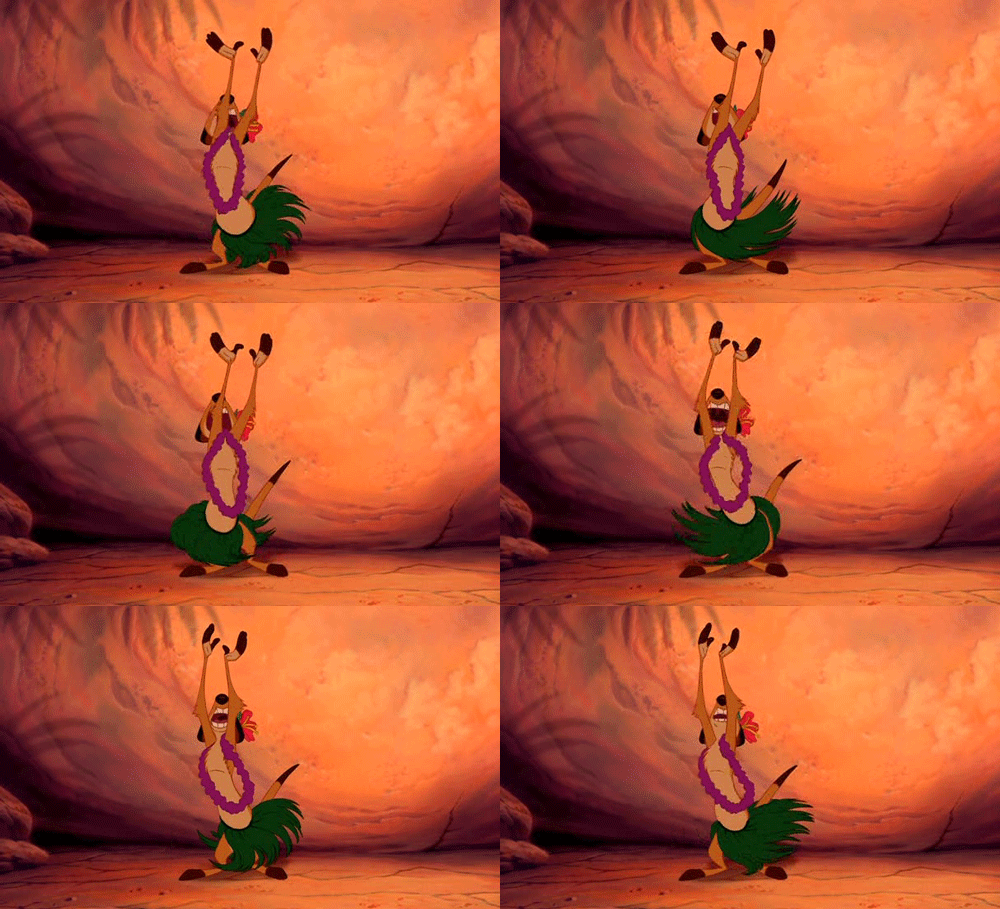

In addition, I thought that Sweeney's point about Timon and Pumbaa's home at the oasis paradise representing  an "alternative lifestyle" to that of order and hierarchy within the boundaries of Pride Rock. One could certainly extrapolate from this idea of Timon and Pumbaa's Hakuna Matata-like "alternative lifestyle" that Disney is surreptitiously portraying Timon and Pumbaa has a homosexual couple that contrast the heterosexual pairings that exist outside of the Oasis. Living in an excluded environment with a no-worries attitude that starkly contrasts the themes of responsibility and tradition that persist within Pride Rock, Timon and Pumbaa effectually serve as surrogate parents to Simba from a young age. Although Sweeney believes that Disney leaves contradictory messages about the tug-of-war between the philosophies of Hakuna Matata and responsibility to family and tradition, I think that Disney ultimately makes the statement that both hold value and that Simba is ultimately able to defeat Scar because he has been intensely exposed to both ideologies. Ultimately, whether or not Timon and Pumbaa represent a homosexual couple, their sexual identities, or lack thereof, have a negligible affect on the messages that their actions and philosophies send to the viewer. 

Tuesday, November 3, 2015

Disney and Race in Disney's "American Legends"


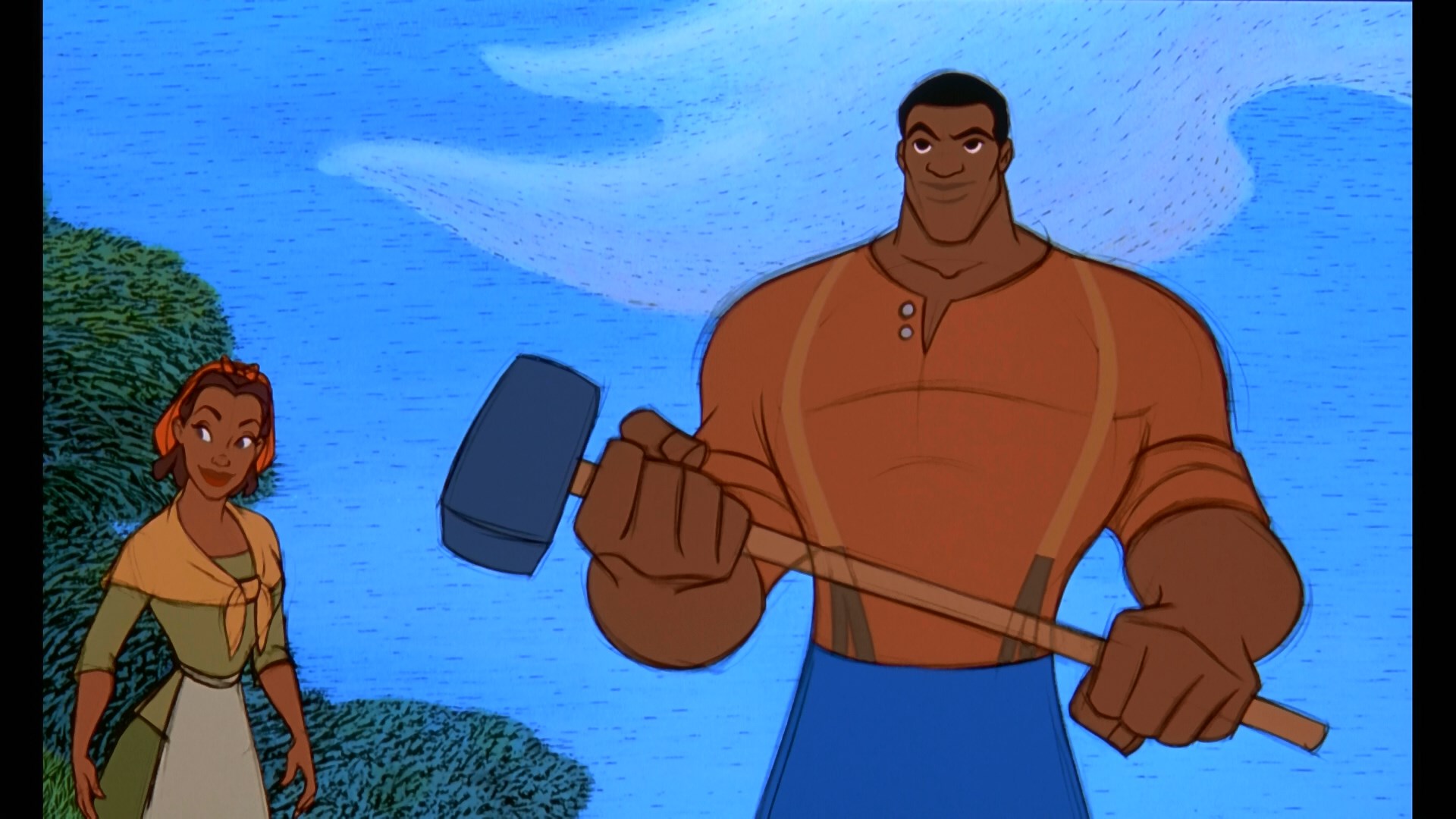
With Disney's The Princess and the Frog being our newest film to study, I thought it would be interesting to note that The Princess and the Frog was not the first Disney film with an African American protagonist. The first major African American Disney story centered on the tale of John Henry, a freed slave who's enormous strength made him a legendary role-model to other African Americans at the time. The short was released in 2002 as direct-to-video animated anthology film hosted by none other than Darth Vader/Mufasa, or James Earl Jones, that was featured on Disney’s American Legends DVD. The short can be seen on the link below

http://www.watchtheyard.com/video/john-henry-disney-watch/

Having never seen this short before until today, I was thoroughly impressed by how well Disney did on the short that effectively portrayed John Henry's story in a powerful way. The short truly sends a positive message about the strength and togetherness of African Americans to pick one another up and make a new life for their self following the Civil War. I thought that the short was amplified by the music played during the story that explains the importance of both hard work and perseverance to children out there. Having seen this short, I'm excited to see how Disney tackles the issue of race in The Princess and the Frog!

Monday, November 2, 2015

Disney and Halloween: Like Peas and Carrots


In honor of Halloween this past weekend, I think a belated Halloween-themed post is in order. I have to preface this post with the statement that Halloween is by and far away my favorite holiday of the year. While Christmas, Easter and Hanukkah get all the glory, Halloween is 100% what you make of it. One person can spend 1 week planning on a costume, while someone else can spend an entire year working on their masterpiece costume and I think that the openness of this is truly unique. The pervasiveness of Disney is never more obvious than over Halloween, where everyone and their mother wants to dress up as Carl and Russell or Elsa and Olaf or Timon and Pumba and roam the streets as their favorite animated characters. In the case of the picture seen above, some members of my family decided to dress up as the protagonists from Disney Pixar's Inside Out. While I'm sure many other families decided to do the same thing, I thought that this was hilarious because of how accurately each one of the individuals in the picture is summed up by the emotions that they're dressed up as, especially little Connor (Anger) and Zoe (disgust). While Disney gets a lot of flak for the messages that they may or may not send, it's impossible to deny Disney's ability to bring people of different backgrounds and personalities together in a totally awesome way.With many new Halloween experiences this year having been away from home and at Duke, I really appreciated this photo of my family that shows that the Cherches' strong Halloween roots have continued with little Connor and Zoe's generation, and I couldn't be more excited about it.

Sunday, October 25, 2015

Morton Film Response: "Simba's Revolution: Revisiting History and Class in The Lion King"

In the midst of writing my own summary and response essay, I have a newfound appreciation for John Morton and  his ability to generate a thought provoking academic "conversation" in his summary and response essay, "Simba's Revolution: Revisiting History and Class in The Lion King." Most broadly, Morton's essay is a direct response to Robert Gooding-Williams' essay, "Disney in Africa and the Inner City: on Race and Space in The Lion King." In his original piece, Gooding-Williams made several argumentative points, including the notion that Disney's Africa in the Lion King is without history until Scar's revolution as well as the claim that the inclusion of the hyenas in the film signifies social inequality.

In my opinion, Morton successfully takes these questionable claims and not only qualifies but expands upon them, as a summary and response essay is supposed to do. By including a mixture of agreeing and then expanding and also disagreeing with Gooding-Williams throughout his essay, Morton establishes a balanced tone that is effective at preventing the reading from feeling lost or overwhelmed by bias.

In direct response to Gooding-Williams' claim that Disney's version of Africa, with its "Circle of Life" anthem, is completely lacking history, Morton points out the fact that even after Scar's revolution, Africa still remains a place that lacks history. Instead of being an oasis, Pride Rock transforms into a wasteland, or in other words a place living in "The Circle of Death."

I especially enjoyed Morton's point that instead of analyzing the struggle between Simba and Scar/the Hyenas in racial terms,  he suggests that the struggle may just represent the eternal power struggle between classic symbols of good and evil. Overall, I thoroughly enjoyed Morton's writing that expanded upon many of Gooding-Williams' arguments in respectful but effective ways, and ultimately adds many good points to the ongoing literary academic conversation.

Thursday, October 15, 2015

The Lion King Film Response

I knew that it was coming. I'd seen it so many times that I could literally close my eyes and picture the scene, but when I watched Mufasa die while watching The Lion King this past weekend, I couldn't help but feel a huge lump in my throat once again. There's just something about the scene that is so powerful and human that it's impossible not to feel emotionally ravaged. In many ways, I feel like the emotional depth of that one scene encompasses the film as a whole which arguably plays with the viewer's emotions more than any other Disney film.


Despite the cruel tragedy of Mufasa's death, The Lion King is undoubtedly one of my favorite non-Pixar Disney films out there. Unlike other stereotypical Disney "love story blah blah blah" films, The Lion King took a more unique coming of age bildungsroman approach that results in an epic overarching storyline that follows Simba's growth in a true lion king. While the film certainly has its flaws as we discussed in class that send negative messages regarding a stratified social hierarchy. While I understand that Disney may very well have intended to promote a rigid class hierarchy. In addition, racism is peppered throughout the film with the hyena's voiced by Whoopi Goldberg and Cheech Marin. Despite these apparent shady aspects in the film, I can openly admit that a mixture of nostalgia and legitimate appreciation for the film makes me more than slightly biased when it comes to The Lion King.

Me holding an actual baby lion like Simba is one of my life's defining moments


What makes the film truly special to me is that despite there being no actually human characters, the plot feels more human than any other Disney film. While other films have a somewhat superficial aspect to them with a forced and overly formulaic love story, The Lion King puts its love story as a secondary plot element to Simba's evolution and story arc, something that I've always loved. Moreover, The Lion King is an incredible film that I could write about for way more than I should, so I'm just gonna end my blog with the intro to the film that plays "The Circle of Life", one of my top 3 favorite songs.


Monday, October 12, 2015

The Little Mermaid Film Response

I truly wish I could’ve made another live blog response for Disney’s The Little Mermaid like I did for Snow White and the Seven Dwarves, I just flat out forgot to live record my view experience. Despite my forgetfulness, I’m excited by the fact that I’ve had time to brood over and analyze the overt as well as clandestine messages hidden within The Little Mermaid. Before I get to the spicy stuff, I just wanted to put it out there that animation-wise, I was somewhat shocked by how minimally the animation changed between Snow White and The Little Mermaid. Don’t get me wrong, the animation style in The Little Mermaid isn’t poorly done or bad in the least, it’s just that I was surprised by how on par the animation of the two films were. Even the animation in water in The Little Mermaid holds very little over the water effects in Snow White, which I’m now starting to realize must have been truly revolutionary for the time period in which the movie was released, but I digress.

It's good, but not that much better than Snow White

Overall, The Little Mermaid is a drastically huge improvement over Snow White and the Seven Dwarves for several different reasons, the main reason being it’s focus on plot. Although Snow White dazzles viewers with its technologically advanced animation effects, I think it’s fair to say that the story is about is one-dimensional and predictable as it gets. The Little Mermaid, on the other hand, is noticeably more layered, starting with the protagonist, Ariel. Unlike Snow White, who is both weak-willed and uninspiring, Ariel is far more complex with a vast array of emotions and motivations that drive the story in various directions. While many make valid criticisms of Ariel’s assumption of many gender role stereotypes, I think that the film still does a good job of using Ariel as a portrayal of the feminine ability to rebel from a patriarchal figure, such as Triton. Also, I think that Eric is a vastly better prince than the creepster from Snow White. While he also has his flaws and superficial tendencies, I think that Eric is also an underhandedly multifaceted character that experiences an internal struggle between doing what people expect from him as a prince and what pursuing what he personally desires. Finally, I have to touch on Ursula. Although in my opinion Ursula is a slightly more annoying villain than the Wicked Queen in Snow White, I do think that Ursula is a more effective villain, due to her dastardly plan of using Ariel as a means to take power away from Triton. The Wicken Queen is motivated by largely superficial reasons, whereas Ursula is driven by her dogged chase for power. While she is undoubtedly flawed, I personally find a complex villain vastly more effective. Take the Joker for example, he has so many layers that he might as well be an onion (gotta love the Shrek references).


While The Little Mermaid certainly has its imperfections, it is undeniably entertaining and asserts itself as a huge improvement for the evolution of Disney films in terms of plot and character development.

Sunday, October 4, 2015

Disney, "The Evil Corporation", Strikes Again

While we primarily study the actual themes and ideas put forth in Disney's movies/shows, I always enjoy reading about up-to-date information about Disney itself as a corporation. As of today, October 4, Disney is  significantly raising its prices on Disneyland tickets. In the article attached at the end of this paper there is an explanation that "the latest price increase specifically targets Disneyland’s annual passholders, a core base that many unofficial Disney blog sites estimate at 1 million. Some have speculated the recent ticket increases are a much-needed way to reduce the large crowds that occurs at Disneyland during some weekends and high-demand seasons."It's hard not to laugh at the ridiculousness of this statement by Disney. The company has legitimately become so unbelievably successful that they can afford to raise the price of their Disneyland tickets so that they can reduce the number of people that come to visit their amusement park. If there's one thing that Wasko got right, it's that Disney as a company is truly an empire that shows no sign of slowing down.

The Disney Empire Strikes Back